

 + than 5000 subscribers
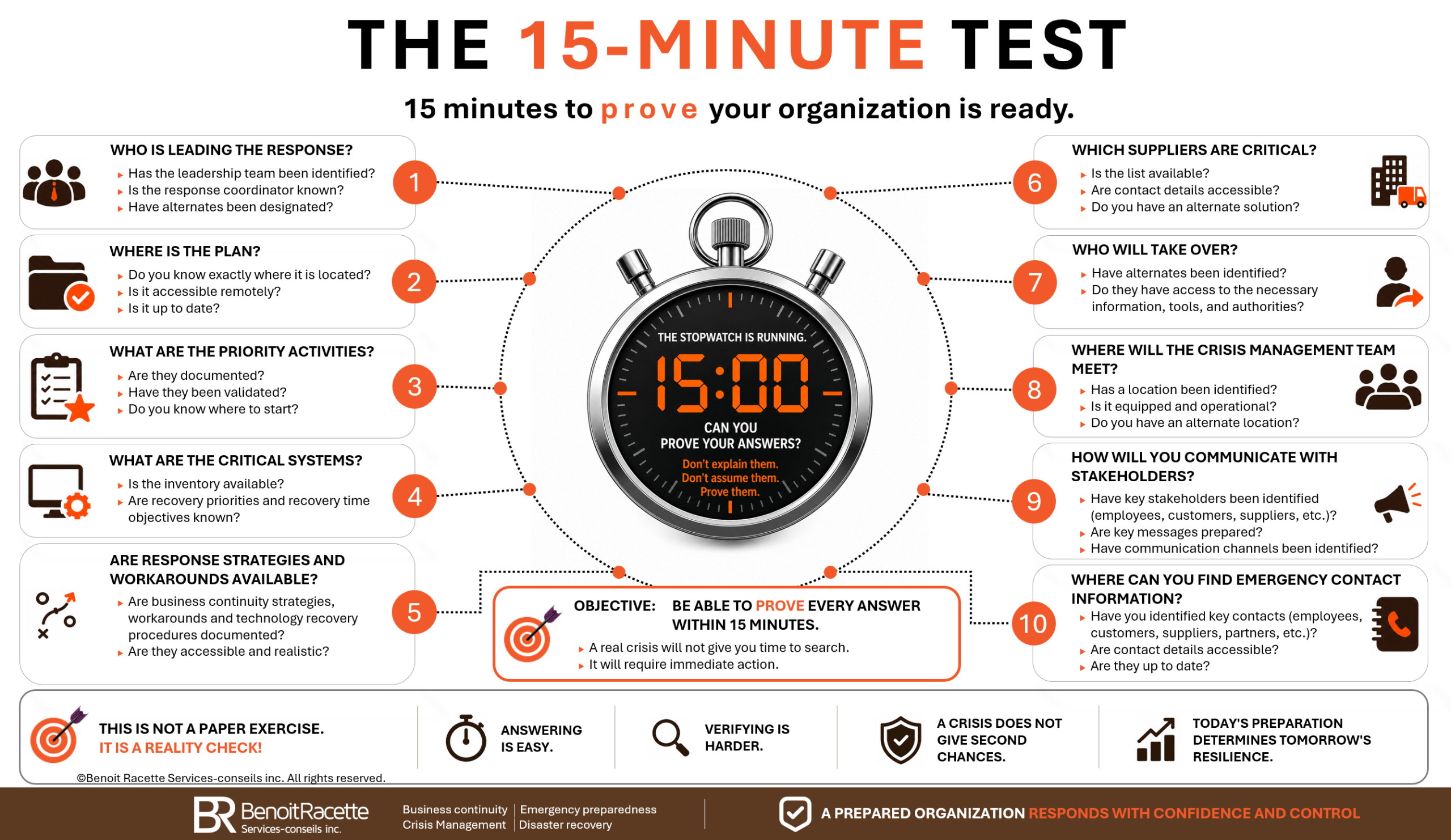
Most organizations believe they are prepared to face a crisis. They have a Business Continuity Plan (BCP) or a Crisis Management Plan (CMP). They have identified their critical activities. Some have even conducted one or two exercises. But when a real disruption occurs, a much simpler question arises:
“Can you find the information you need within 15 minutes?”
When I facilitate workshops or exercises, I often observe the same phenomenon. If I ask: “Do you know where your business continuity plan is?”
The answer is almost always: “Yes.”
If I follow up with: “Can you show it to me right now?” The situation often becomes quite different:
- The document may be stored on a shared drive.
- Or in a specialized platform.
- Or on the laptop of an employee who is unavailable.
- Or nobody is completely certain which version should be used.
This difference between thinking you know and being able to demonstrate often represents the gap between a prepared organization and a vulnerable one. The 15-Minute Test is therefore not intended to verify what people think they know. It is designed to verify what they are capable of finding, accessing, and using quickly.
Why 15 Minutes?
Because the first few minutes of a crisis are often the most important. When a major event occurs, leaders must quickly:
- Understand the situation
- Mobilize the necessary resources
- Protect people
- Make decisions
- Communicate with stakeholders
- Maintain critical operations
Every minute spent searching for critical information increases the risk of mistakes, delays, and escalation. The objective is not to answer questions from memory but to demonstrate that essential information is:
- Available
- Accessible
- Up to date
- Known by the people who will need it
The 10 Questions Every Organization Should Be Able to Validate Quickly
1- Who Is Leading the Response?
When a crisis occurs, roles and responsibilities must be clearly established.
- Who is coordinating the response?
- Who is making decisions?
- Who serves as the alternate if the primary individual is unavailable?
An organization that must debate these questions during a crisis has already lost valuable time.
2- Where Is the Plan?
Having a plan is not enough. You must also be able to locate it quickly.
- Is the plan accessible remotely?
- Do the right people know where to find it?
- Is the available version up to date?
3- What Are the Priority Activities?
Not every activity is critical. Leaders should be able to quickly identify what:
- Must absolutely be maintained;
- Can be temporarily suspended;
- Must be restored first.
4- What Are the Critical Systems?
In most organizations, operations depend heavily on technology. Do responsible individuals know:
- Which systems are critical?
- Their order of priority?
- Their expected recovery time objectives?
This information should be immediately accessible.
5- Are Response Strategies and Workarounds Available?
Understanding a risk is not enough. You must also know how operations will continue when a disruption occurs.
- Have continuity strategies been documented?
- Do technology recovery procedures exist?
- Are they realistic and practical?
6- Which Suppliers Are Critical?
Many organizations depend heavily on external partners. In some cases, the loss of a supplier can have an impact just as significant as an internal failure.
- Are supplier lists available?
- Are contact details up to date?
- Have alternative solutions been identified?
7- Who Will Take Over?
Absences are part of reality. Illness, vacations, unexpected departures, or temporary unavailability can quickly complicate an already difficult situation.
- Have alternates been identified?
- Do they have access to the necessary information, tools, and authorities?
8- Where Will the Crisis Management Team Meet?
Many organizations have established a crisis management team. But have they identified a location?
- Is the site operational?
- Are access arrangements available?
- Is there an alternate location?
9- How Will You Communicate?
A crisis is also a communications challenge.
- Have key stakeholders been identified?
- Are key messages prepared?
- Are communication channels clearly defined?
These elements should never be improvised under pressure.
10- Where Can You Find Emergency Contact Information?
This question appears simple. Yet it is often more complex than it seems. Are the following contact lists readily available and up to date?
- Employees
- Suppliers
- Partners
- Crisis management team members
This Is Not a Theoretical Exercise
One of the most common mistakes is turning preparedness into a documentation exercise:
- Verify that documents exist.
- Confirm that they have been approved.
- Note that they are stored somewhere.
- Then consider the work complete.
Reality is different. A crisis will never ask whether your plan exists. It will ask whether you can use it. That is why the 15-Minute Test is not about answering questions.
It is about demonstrating the answers.
How to Conduct the Test
The process is intentionally simple.
1- Select a manager, coordinator, or member of the crisis management team.
2- Ask the ten questions.
3- For each question, ask: “Can you show it to me right now?”
- Not in an hour.
- Not tomorrow.
- Right now.
- Show me:
- The plan.
- The contact lists.
- The supplier lists.
- The procedures.
- The strategies.
- The critical systems information.
The purpose of this exercise is not to assign blame. The objective is to identify weaknesses before a real crisis exposes them.
Conclusion: A Prepared Organization Responds with Confidence and Control
Organizational resilience is not based solely on the quality of plans. It depends on people’s ability to quickly access the information they will need when pressure is real.
The 15-Minute Test is intentionally simple. Yet it often reveals significant gaps. Because ultimately, a crisis will not ask what you know. It will ask what you can demonstrate. If a major disruption occurred today, could your organization validate each of these ten answers within 15 minutes?
Strategic Support to Strengthen Your Resilience
At Benoit Racette Services-conseils inc., we help organizations protect their critical operations, ensure the safety of their teams, and maintain the trust of their clients—even when a major disruption occurs.
With nearly 30 years of specialized experience in business continuity, crisis management, emergency preparedness, and IT disaster recovery planning, Benoit Racette supports organizations with rigor and confidentiality, transforming complex challenges into concrete solutions tailored to their reality.
- Resilience diagnostic
- Updated business continuity plan
- Operational crisis management plan
- Realistic IT disaster recovery plan
- Tests and exercises to validate plans and strengthen teams
- Targeted training in continuity, crisis management, and operational preparedness
These are the tools that distinguish organizations that suffer… from those that respond with control.
Want to assess your vulnerabilities, refine your plans, or better prepare your organization?
Contact us: [email protected]