

 + than 5000 subscribers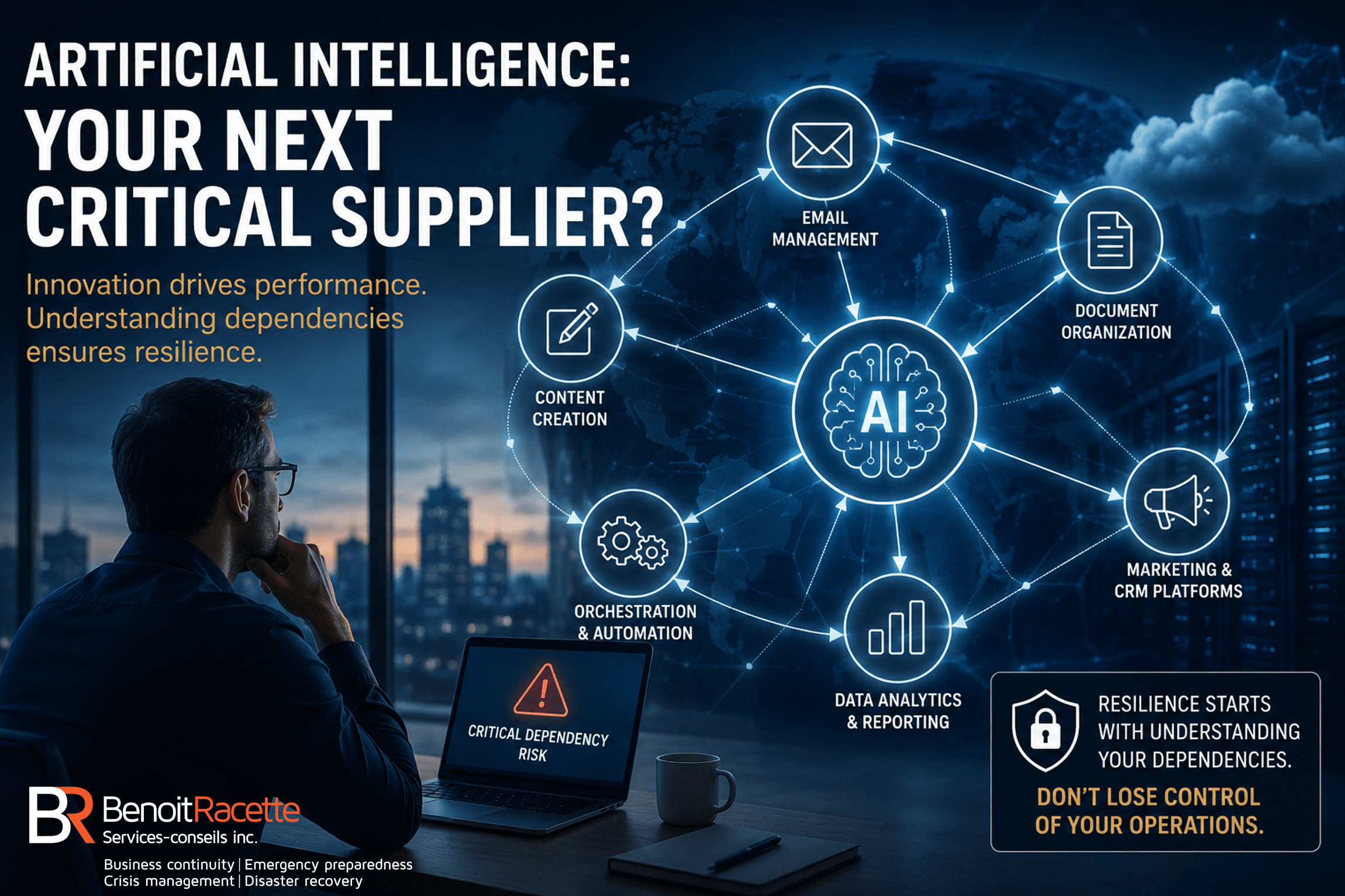
A Revolution Already Underway
Artificial intelligence is probably one of the most important productivity drivers that SMEs and self-employed professionals have experienced in a long time.
I use it myself every day as part of my work. Like many professionals, I see considerable time savings and an impressive ability to accelerate certain tasks, improve the quality of deliverables and reduce the effort devoted to repetitive activities.
The purpose of this article is certainly not to question the use of AI. Quite the opposite.
A Reality That Made Me Think
Over the past few months, I have attended several training sessions on artificial intelligence offered by different instructors from Quebec, the United States and Europe. The objective was simple: to better understand these tools and learn how to use them more effectively in my professional practice.
Three observations kept coming back repeatedly, but they particularly struck me this week.
1-Instructors explained that:
- They no longer organized their emails.
- They no longer really managed their files and folders.
- They no longer always knew how their information was organized or structured.
—–>>>>>> Artificial intelligence was now taking care of all of that for them.
2- In some cases:
- One artificial intelligence managed emails.
- A second produced content.
- A third fed marketing tools or customer relationship management platforms.
- A fourth orchestrated all operations in the background.
3- Even more surprisingly:
- Some of these artificial intelligences were themselves connected to one another to collaborate automatically and exchange information without human intervention.
The result is impressive from a productivity standpoint. But this reality immediately triggered my instincts as a specialist in organizational resilience and risk management.
When a Tool Becomes a Dependency
In the field of organizational resilience, we pay particular attention to critical dependencies. For example:
- A single supplier.
- A key person.
- An essential technology.
- A single data centre.
- A single Internet connection.
Whenever an organization becomes unable to operate without a specific element, that element becomes a risk that must be understood, assessed and managed. Artificial intelligence is gradually entering this category.
A Dependency That Goes Beyond a Single Supplier
For a long time, organizations have learned to identify their critical suppliers. Today, some businesses are creating, without necessarily realizing it, complete chains of dependencies between several artificial intelligence services. Here is a concrete illustration of such a chain:
- One platform writes emails.
- Another organizes documents.
- A third generates marketing content.
- A fourth analyzes data or produces reports.
- A fifth acts as the conductor and coordinates the whole system.
And often, these tools communicate with one another automatically. The problem is not the existence of these automations.
The risk appears when nobody in the organization truly understands how the whole system works, where the information is located or how to continue operations without these tools. At that point, the dependency no longer concerns a single supplier. It concerns an entire ecosystem whose rules, technologies and decisions largely escape the organization using it.
A Dependency Often Located in Another Jurisdiction
A large proportion of artificial intelligence tools used daily by Canadian SMEs are developed, hosted and operated outside Canada. That is not a problem.
However, it means that these services are subject to different regulatory frameworks, different laws and different government decisions.
Recent debates surrounding technology restrictions, export controls and certain limitations imposed on advanced models for national security reasons show that access to these technologies can evolve quickly depending on geopolitical or regulatory issues. For many organizations, this risk is no longer purely theoretical.
What Happens if AI Disappears Tomorrow Morning?
Imagine that an artificial intelligence service becomes temporarily unavailable for a few days. Existential questions would immediately arise:
- Do teams still know how to find the information?
- Are processes sufficiently documented?
- Does knowledge remain within the organization?
- Do employees still understand the logic behind certain decisions or automations?
- Is there an alternative solution or a degraded operating mode?
The more artificial intelligence takes up space in an organization, the more important these questions become.
The Real Risk: Losing the Understanding of Your Own Operations
Automation is not the problem. The gradual loss of understanding of processes, however, can become one.
When an organization progressively entrusts its emails, documents, marketing, analyses or certain operational decisions to a set of interconnected artificial intelligences, it must ensure that it retains control over its activities.
A resilient organization must always be able to operate, even in degraded mode. This is one of the fundamental principles of business continuity.
Innovation becomes a risk when technology understands your processes better than you do.
Our Risk Assessment Models Must Evolve
In many organizations, artificial intelligence is beginning to appear in organizational risk profiles. That is an excellent thing.
However, the analysis is still very often limited to governance, confidentiality, protection of personal information or acceptable use. These concerns are important, but they are probably no longer sufficient.
As organizations multiply tools, agents and automations, a new category of risk is emerging: dependencies between artificial intelligences themselves:
- What is the main artificial intelligence used by the organization?
- What other platforms are connected to it?
- Which business processes depend on this ecosystem?
- Are there cascading dependencies between several tools?
- Does the organization still understand how its processes function when automation is removed from the equation?
In my opinion, traditional risk assessment models will need to evolve quickly in order to integrate this new reality. Because tomorrow, the question will probably no longer be: “Do you use artificial intelligence?”
The real question will instead be: “Do you still understand your operations without it?”
In Conclusion: Innovating Without Creating a New Single Point of Failure
Artificial intelligence is not a risk to avoid. It is an extraordinary opportunity.
But like any technology that becomes essential to operations, it deserves to be considered for what it is progressively becoming in many organizations: a critical supplier.
The question is therefore not whether you should use artificial intelligence.
The real question is the following:
“If your artificial intelligence were no longer available tomorrow morning, how long would it take your organization to resume normal operations?”
Strategic Support to Strengthen Your Resilience
At Benoit Racette Services-conseils inc., we help organizations protect their critical operations, ensure the safety of their teams, and maintain the trust of their clients—even when a major disruption occurs.
With nearly 30 years of specialized experience in business continuity, crisis management, emergency preparedness, and IT disaster recovery planning, Benoit Racette supports organizations with rigor and confidentiality, transforming complex challenges into concrete solutions tailored to their reality.
- Resilience diagnostic
- Updated business continuity plan
- Operational crisis management plan
- Realistic IT disaster recovery plan
- Tests and exercises to validate plans and strengthen teams
- Targeted training in continuity, crisis management, and operational preparedness
These are the tools that distinguish organizations that suffer… from those that respond with control. Want to assess your vulnerabilities, refine your plans, or better prepare your organization?
Contact us: [email protected]