

 + than 5000 subscribers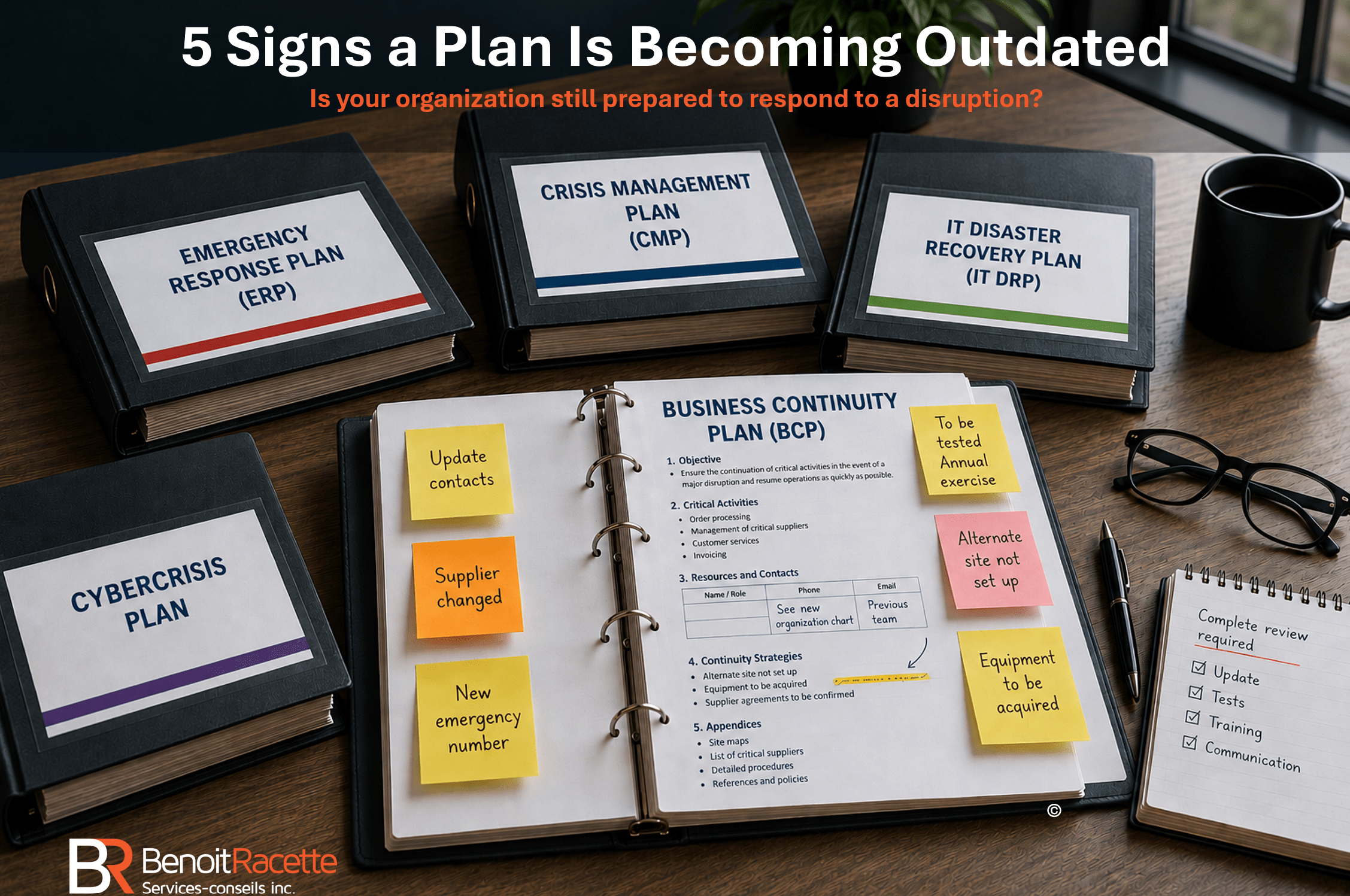
Most organizations maintain at least some procedures or plans required by regulations, such as a fire safety plan. However, business continuity plans, crisis management plans, IT disaster recovery plans, and emergency preparedness plans are still absent in many organizations.
When they do exist, these plans are often developed in response to a regulatory requirement, an insurance request, an audit, a significant incident, or simply as part of a sound governance approach.
Whether mandatory or voluntary, however, all plans share one common characteristic: they become outdated over time.
Organizations evolve continuously. Employees change, technologies advance, suppliers are replaced, and new risks emerge. Yet the plans designed to help organizations respond to these changes are not always updated at the same pace.
More concerning is the fact that some organizations believe they are protected simply because a document exists, even though it no longer reflects their actual ability to respond to a disruption.
Here are five signs that may indicate a plan is becoming outdated and should be reviewed.
1- Contact Information Is No Longer Up to Date
This is often the first warning sign.
Employees have left the organization, managers have changed roles, or suppliers have been replaced. Yet the old information remains in the document.
If contact information is outdated, it is reasonable to wonder what other elements of the plan may be outdated as well.
2- Roles and Responsibilities Have Changed
Organizational structures evolve constantly.
Teams are merged, new positions are created, and responsibilities are reassigned. A plan that assigned the right tasks to the right people three years ago may no longer reflect today’s reality. A critical responsibility assigned to someone who no longer holds that position is a significant warning sign.
3- Planned Investments Were Never Implemented
This situation is more common than many organizations realize.
The plan may call for the use of an alternate site, replacement equipment, redundant systems, or agreements with specialized service providers. However, due to budget constraints, time limitations, or shifting priorities, some of these measures were never implemented. As a result, the plan remains valid on paper but becomes partially unrealistic in practice.
4- The Plan Has Never Been Tested
A document may appear complete and coherent until the moment it needs to be implemented.
Exercises and tests help validate assumptions, roles and responsibilities, procedures, and planned resources. Without this validation, it is difficult to be confident that the plan will perform as intended when it is needed.
5- Nobody Knows It Exists
Another revealing sign appears when the people concerned are unaware that the plan exists or do not know where to find it. An excellent document that remains unknown to those who need it will often be just as useful as no document at all during an emergency.
A Simple Question to Ask Yourself
The presence of one or more of these signs does not necessarily mean that your plan has become useless. It does, however, suggest that it should probably be reviewed, updated, or validated. Before undertaking a complete revision, there is a simple way to quickly assess the situation. Ask yourself the following question:
“If a major incident occurred tomorrow morning, would you be confident that your team could implement the plan exactly as it is written today?”
If the answer is hesitant or uncertain, it is probably time to review, test, or validate some of the plan’s underlying assumptions.
What If You Don’t Have a Plan?
The absence of a plan generally represents an even greater risk than an outdated one.
Before drafting a document, it is important to take the time to assess your situation, your risks, your critical activities, and your actual needs. An effective plan is not a generic template downloaded from the Internet; it must reflect the reality of your organization, its constraints, and the disruptions it may face.
Whether the objective is business continuity, crisis management, IT disaster recovery, or emergency preparedness, the first step is often understanding what truly needs to be protected before determining how to protect it.
Conclusion
A plan does not become ineffective overnight. It gradually becomes outdated, often without anyone noticing. The objective is not to constantly rewrite plans, but rather to ensure they continue to reflect the organization’s reality, resources, and capabilities.
After all, during a major disruption, it is not the document itself that will be tested, but the organization’s ability to execute what it contains.
Strategic Support to Strengthen Your Resilience
At Benoit Racette Services-conseils inc., we help organizations protect their critical operations, ensure the safety of their teams, and maintain the trust of their clients—even when a major disruption occurs.
With nearly 30 years of specialized experience in business continuity, crisis management, emergency preparedness, and IT disaster recovery planning, Benoit Racette supports organizations with rigor and confidentiality, transforming complex challenges into concrete solutions tailored to their reality.
- Resilience diagnostic
- Updated business continuity plan
- Operational crisis management plan
- Realistic IT disaster recovery plan
- Tests and exercises to validate plans and strengthen teams
- Targeted training in continuity, crisis management, and operational preparedness
These are the tools that distinguish organizations that suffer… from those that respond with control.
Want to assess your vulnerabilities, refine your plans, or better prepare your organization?
Contact us: [email protected]