

 + than 5000 subscribers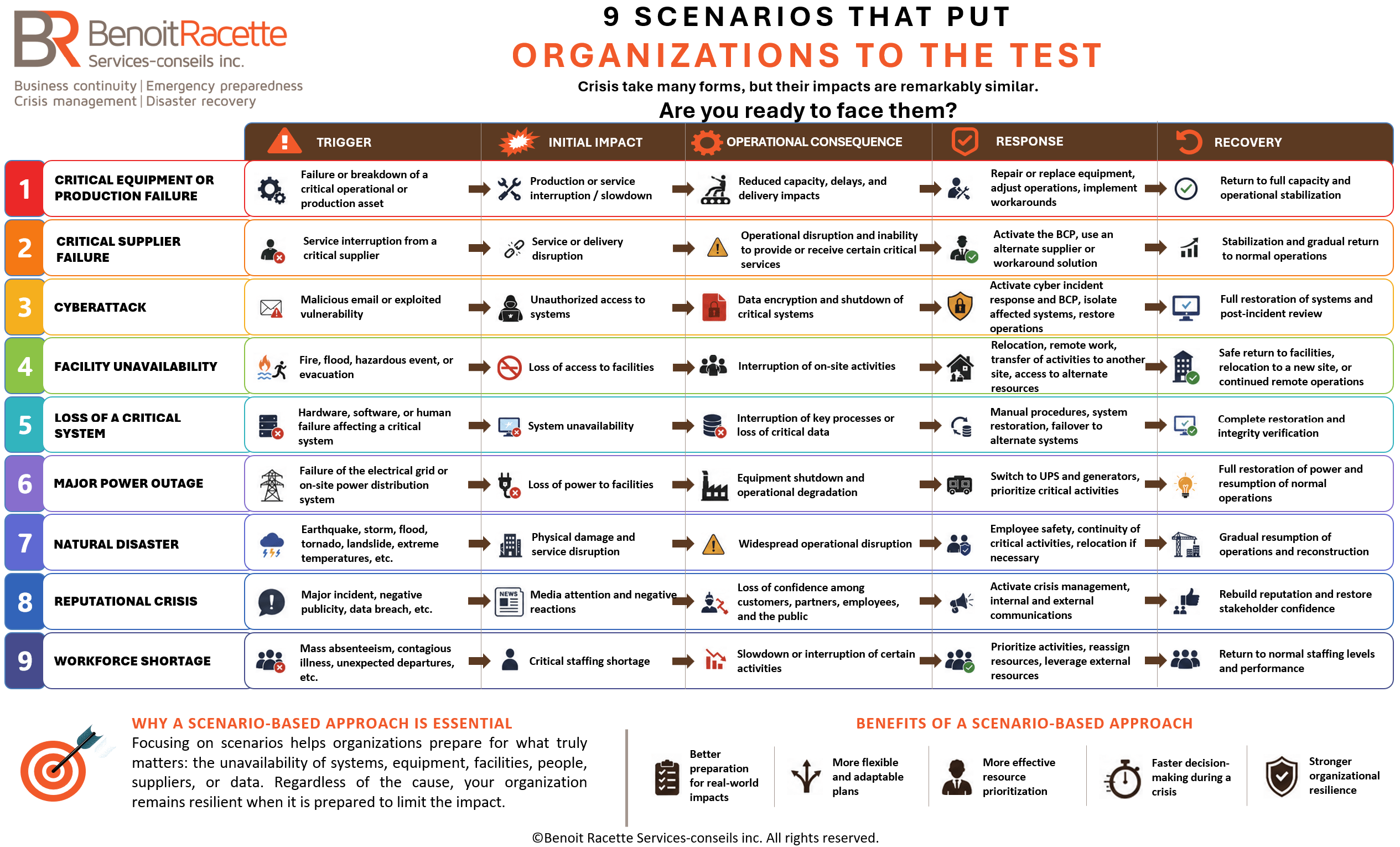
Crises come in many forms.
Some are sudden and highly visible. Others develop gradually over time. Some make headlines, while others remain largely unnoticed by the public.
Yet when we look at the events that have genuinely disrupted organizations in recent years, one observation stands out: the causes may differ, but the consequences are often remarkably similar.
This is precisely why the most resilient organizations today favor a scenario-based approach rather than maintaining a multitude of separate plans for every possible type of incident.
Before Documenting: Identify the Scenarios That Truly Matter
A scenario-based approach is not about arbitrarily selecting a few events and building plans around them.
It begins with a structured reflection aimed at understanding the major disruptions to which an organization is exposed—or could reasonably be exposed.
Before drafting any plan, it is important to ask several key questions:
- What events could significantly disrupt our operations?
- What are our key dependencies?
- Which incidents would have the greatest impact on our activities?
- How would we respond to these situations?
- What would the actual operational consequences be?
Once this exercise has been completed, it becomes possible to identify similarities among different disruptions. For example, a fire, gas leak, prolonged power outage, major water supply issue, or security incident can all lead to the same consequence: the inability to use a facility.
Although the triggering events differ, the continuity strategies required to address them are often very similar. These situations can therefore be grouped under a single scenario: facility unavailability.
The same exercise can be applied to systems, suppliers, critical equipment, workforce availability, or reputational issues. This is how business continuity scenarios are developed.
In a crisis management context, we may refer to crisis families. In business continuity, we generally speak of continuity scenarios. In both cases, the underlying logic remains the same: grouping situations that require similar responses to avoid an unnecessary proliferation of plans and procedures.
This initial analysis requires some effort, but it significantly simplifies documentation, exercises, team training, and, most importantly, ongoing plan maintenance.
The 9 Most Commonly Encountered Scenarios
While every organization is unique, certain scenarios consistently emerge in business continuity initiatives.
Among the most common are:
- Natural Disaster
- Reputational Crisis
- Cyberattack
- Critical Equipment or Production Failure
- Critical Supplier Failure
- Facility Unavailability
- Major Power Outage
- Workforce Shortage
- Loss of a Critical System
Of course, this list is not universal. Depending on your industry, regulatory environment, technology landscape, or business model, some scenarios may be added, combined, or adapted.
- The objective is not to predict everything.
- The objective is to effectively address the operational consequences your organization may face.
Understanding the Logic Behind a Scenario
One of the major advantages of this approach is that it avoids creating a separate plan for every imaginable event. Consider a simple example:
- A gas leak, fire, security threat, major air quality issue, or prolonged loss of essential services can all result in the evacuation of a building.
In an Emergency Response Plan (ERP), each of these situations will typically require a specific procedure because the initial response actions will differ. However, once the evacuation has been completed, the continuity concerns become very similar:
- Where will employees work?
- How will critical activities be maintained?
- How will we communicate with customers?
- How will we access the resources we need?
- How will operations resume?
This is why, within a Business Continuity Plan (BCP), Crisis Management Plan (CMP), or Crisis Communications Plan (CCP), these events can be grouped under a single scenario: facility unavailability.
The same logic applies to many other situations. For example, a cyberattack, major hardware failure, or human error may have very different causes but lead to the same consequence: the loss of a critical system. Rather than documenting dozens of separate plans, a scenario-based approach allows organizations to focus on the operational impacts that truly need to be managed.
Benefits of a Scenario-Based Approach
When properly implemented, this approach offers several advantages:
- Better preparation for real-world impacts.
- Simpler plans that are easier to maintain.
- Fewer documents to manage.
- Greater clarity regarding roles and responsibilities.
- More realistic exercises and simulations.
- Faster decision-making during a crisis.
- More effective use of available resources.
- Stronger organizational resilience.
It also helps organizations avoid a common pitfall: accumulating plans that quickly become outdated because there is insufficient time to maintain them.
A Simple Question to Ask Yourself
“If a major disruption occurred tomorrow morning, would your organization be able to quickly determine which scenario it is facing and which strategies should be activated?”
If the answer is uncertain, it may be time to reconsider how your plans are structured.
What If You Do Not Yet Have Any Plans?
The good news is that you do not need to document dozens of scenarios to get started.
An effective approach begins by identifying the major disruptions to which your organization is exposed, grouping them according to their operational consequences, and then gradually developing a small number of robust scenarios that cover the majority of your risks.
This approach typically produces results that are more practical, easier to maintain, and far more useful during an actual crisis.
Conclusion
Organizations cannot prevent every crisis. They cannot control the weather, cybercriminals, technology failures, suppliers, or unexpected events.
What they can do, however, is prepare for the consequences of those events. That is the true strength of a scenario-based approach. When causes change but impacts remain similar, resilience is not about predicting every possible incident. It is about being prepared to manage the consequences effectively when they occur.
Strategic Support to Strengthen Your Resilience
At Benoit Racette Services-conseils inc., we help organizations protect their critical operations, ensure the safety of their teams, and maintain the trust of their clients—even when a major disruption occurs.
With nearly 30 years of specialized experience in business continuity, crisis management, emergency preparedness, and IT disaster recovery planning, Benoit Racette supports organizations with rigor and confidentiality, transforming complex challenges into concrete solutions tailored to their reality.
- Resilience diagnostic
- Updated business continuity plan
- Operational crisis management plan
- Realistic IT disaster recovery plan
- Tests and exercises to validate plans and strengthen teams
- Targeted training in continuity, crisis management, and operational preparedness
These are the tools that distinguish organizations that suffer… from those that respond with control.
Want to assess your vulnerabilities, refine your plans, or better prepare your organization?
Contact us: [email protected]