

 + than 5000 subscribers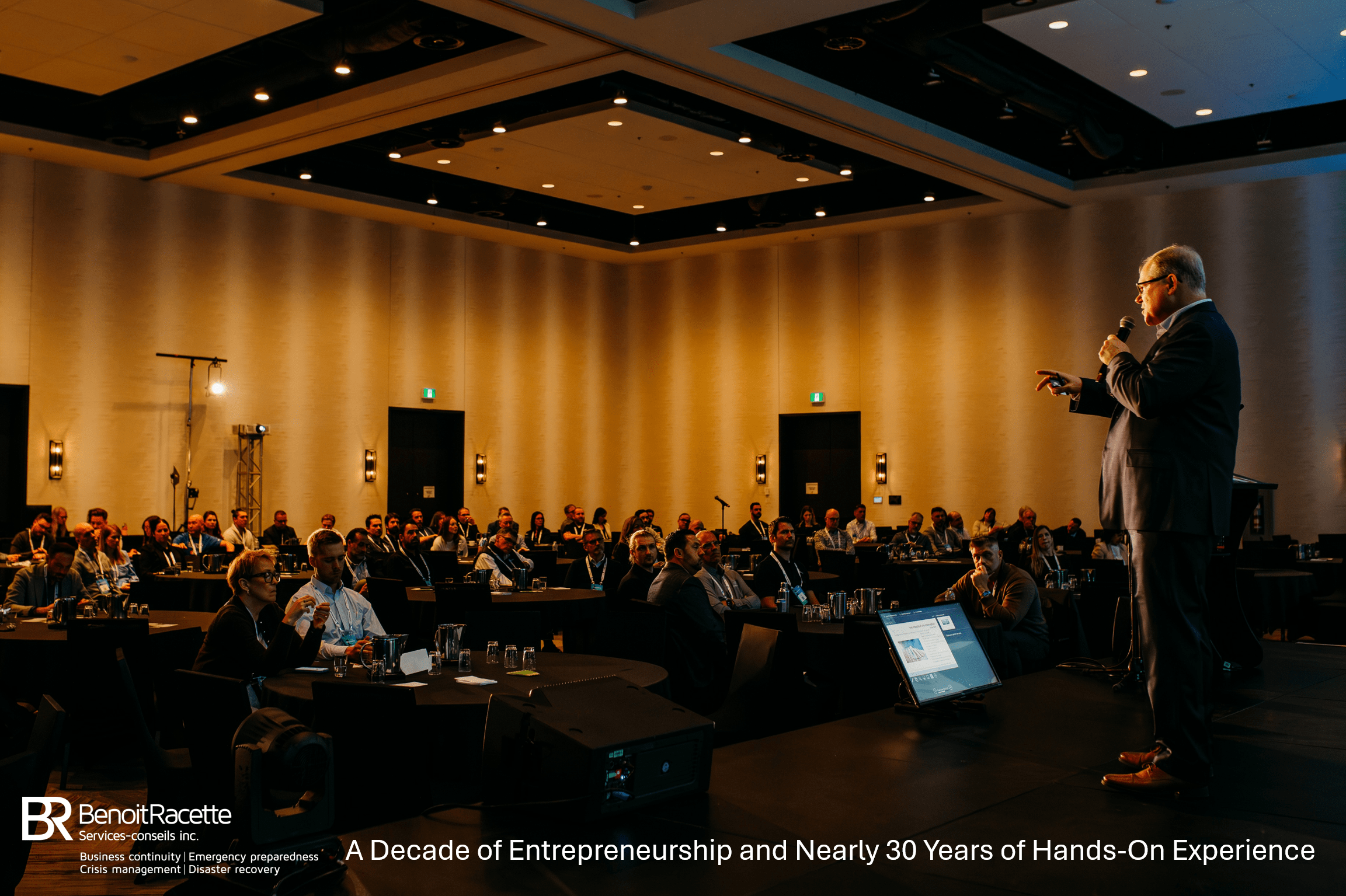
For nearly 30 years, Benoit Racette have been working in the fields of business continuity, crisis management, and organizational resilience. Over the years, I have had the opportunity to support organizations of all sizes in environments that were as varied as they were complex. We are pleased to give him the opportunity to share insights drawn from nearly 30 years of hands-on experience, combined with a decade of entrepreneurship dedicated to helping organizations address the growing challenges of organizational resilience.
A Perspective Shaped by a Decade of Entrepreneurship and Real-World Experience
My journey in this field began in the late 1990s, in highly operational contexts involving real disruptions to business operations. Since then, the industry has evolved significantly: from an approach initially focused on technology and emergency measures, it has become structured around integrated practices, recognized standards, and a growing organizational awareness of the potential impacts of disruptions.
In 2016, I chose to continue this journey independently, as an entrepreneur. It was a defining decision that allowed me to fully leverage the hands-on experience acquired within large organizations while developing a more agile, focused, and results-oriented approach.
Today, as I mark nearly 10 years in business, the perspective gained over time allows me to draw several conclusions.
Experience Cannot Be Improvised
Business continuity and crisis management are not disciplines learned solely from books. They are developed through mandates, exercises, and above all, real-life situations.
Over the course of these three decades, I have participated in the management of numerous crises, contributed to the development of hundreds of plans, and supported organizations during critical moments when decisions had to be made quickly, rigorously, and with sound judgment.
Today, this experience makes it possible to:
- Quickly identify the real issues;
- Distinguish theoretical solutions from practical and applicable ones;
- Guide organizations toward realistic, testable, and sustainable approaches.
The balance between theory and practice remains essential, a reality that has been evident since the beginning of my career and continues to make a difference today.
The Choice of Independence: A Strategic Lever
Transitioning to an independent practice was not simply a change in professional status. It was a strategic decision. Being independent allows me to:
- Work directly with decision-makers;
- Adapt approaches without organizational bureaucracy;
- Deliver tailored solutions without compromise;
- Maintain a high level of involvement in every engagement.
In a field where every organization faces unique realities, this flexibility becomes a significant advantage.
Entrepreneurship: A Demanding Yet Structuring Reality
Beyond projects and deliverables, the past few years have also been shaped by a reality that is often less visible: entrepreneurship.
Working independently means accepting a certain level of uncertainty. Business cycles fluctuate, alternating between highly intensive periods and quieter moments, requiring constant adaptability, planning, and priority management.
It also means taking responsibility for every aspect of the business. On a daily basis, this involves acting as the first responder for a wide range of matters: business development, client relations, negotiations, marketing, conferences, participation in events and trade shows, as well as administrative management, legal matters, accounting, information technology, and operational organization.
In this context, building and maintaining a strong network becomes essential. Over the years, I have had the opportunity to surround myself with recognized collaborators and external experts who share common values and complement my service offering. The ability to mobilize the right expertise at the right time is a key factor in effectively meeting organizational needs.
This reality also requires sustained commitment. Working hours often extend beyond traditional schedules, including evenings, weekends, and often even during vacations. It also leads to the development of a constant mindset of observation and analysis, as business and improvement opportunities continuously arise in many different contexts.
Over time, this entrepreneurial experience has proven to be a natural extension of my professional practice: it strengthens rigor, responsiveness, and the ability to provide concrete and effective support to organizations.
Approach Rooted in Operational Reality
Over the past 10 years, I have unfortunately observed that the majority of organizations still do not have business continuity plans (BCP), crisis management plans (CMP), or disaster recovery plans (DRP), and that those which do often are not as prepared as they believe.
Organizations operating in regulated industries are often required to comply with obligations related to emergency management, business continuity, and the maintenance of technological capabilities. In reality, this only applies to a limited portion of organizations across all industries and sectors in the country. I estimate this proportion to be less than 25% (industries such as financial services, petrochemical, healthcare/hospitals, public transportation, airports, etc.).
For all organizations, the issue is not simply whether a plan exists, but whether they are truly capable of implementing it effectively. In practical terms, several recurring realities are observed in the field:
- Lack of executive support for a functional resilience program;
- Limited understanding of risks and impacts in the event of a major disruption;
- Poor understanding of roles and responsibilities;
- Difficulty making decisions under highly unusual pressure situations;
- Lack of true integration of plans into day-to-day operations;
- Incomplete and outdated plan documentation;
- Failure to conduct tests and exercises to validate actual capabilities.
When truly integrated and operational, these plans go beyond risk management: they become strategic tools that strengthen stakeholder confidence, protect reputation, and support business development.
This is why my approach goes beyond deliverables, with a strong emphasis on operationalization, strategic consistency, and the concrete preparedness of teams.
A Combination That Makes the Difference
Today, it is nearly 30 years of experience combined with a decade of independent practice that define my approach. This combination provides:
- A strategic vision supported by strong field experience;
- The ability to quickly adapt to client realities;
- A rigorous, confidential, and results-oriented advisory approach.
Looking Ahead
The challenges surrounding organizational resilience continue to evolve: cyberattacks, climate events, technological dependencies, and increasing regulatory pressures.
In this context, experience remains a key factor, but it must continuously adapt.
It is with this perspective that I continue my commitment to organizations: transforming complex challenges into practical solutions and helping build organizations capable of facing disruptions, whatever form they may take.
Conclusion
Over the years, one thing has remained constant: an organization’s resilience does not rely solely on its plans, but on its actual ability to implement them when the situation demands it.
Nearly 30 years of accumulated experience, combined with a decade of independent practice, now make it possible to address these challenges with both a strategic and pragmatic perspective, while taking into account operational realities, organizational constraints, and stakeholder expectations.
In a context where disruptions are becoming increasingly frequent and complex, proper preparation is no longer a theoretical exercise, but a genuine organizational advantage.
It is this conviction that guides each of my interventions.
Strategic Support to Strengthen Your Resilience
At Benoit Racette Services-conseils inc., we help organizations protect their critical operations, ensure the safety of their teams, and maintain the trust of their clients—even when a major disruption occurs.
With nearly 30 years of specialized experience in business continuity, crisis management, emergency preparedness, and IT disaster recovery planning, Benoit Racette supports organizations with rigor and confidentiality, transforming complex challenges into concrete solutions tailored to their reality.
- Resilience diagnostic
- Updated business continuity plan
- Operational crisis management plan
- Realistic IT disaster recovery plan
- Tests and exercises to validate plans and strengthen teams
- Targeted training in continuity, crisis management, and operational preparedness
These are the tools that distinguish organizations that suffer… from those that respond with control.
Want to assess your vulnerabilities, refine your plans, or better prepare your organization?
Contact us: [email protected]