

 + than 5000 subscribers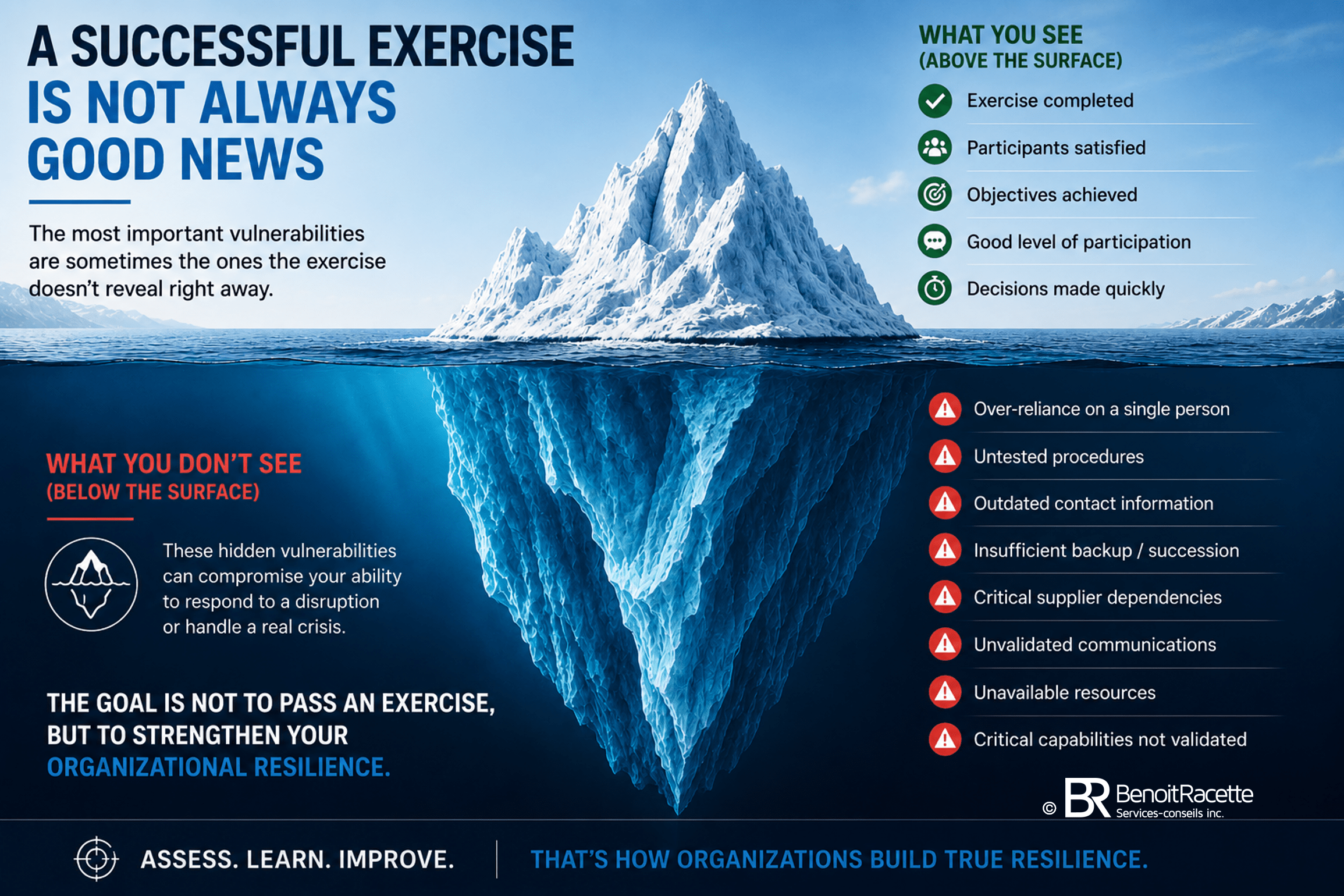
“The exercise went very well.” I often hear this statement at the end of a business continuity, crisis management, or emergency management exercise.
Participants were engaged. Discussions were productive. Decisions were made quickly. The overall atmosphere was positive. « Great news ».
But does that mean the organization is truly prepared to deal with a major disruption, a cyberattack, an extended outage, or a complex crisis? “Not necessarily ».
Over the years, I have observed a recurring phenomenon: the risk of complacency that can follow an exercise considered “successful.” Before concluding that an exercise was a success, organizations must first determine what they intended to validate and how success will be measured.
Successful According to What Criteria?
At the end of an exercise, it is common to hear comments such as:
- “It went well.”
- “We successfully completed the exercise.”
- “Participants were satisfied.”
My first question is usually: According to what criteria?
An exercise should never be evaluated solely on general impressions or participant satisfaction. Like any structured activity, it should be based on clearly defined objectives and success criteria established before the exercise takes place. Without these elements being identified during the planning phase, it becomes difficult to objectively determine whether an exercise was successful, partially successful, or unsuccessful.
An Exercise Must Deliver Value
Conducting an exercise requires time, resources, and the attention of numerous participants. It is therefore legitimate to ask: why conduct an exercise at all?
The answer should always be the same: to provide value to the organization.
That value may take several forms:
- validating the effectiveness of a plan or procedure;
- confirming understanding of roles and responsibilities;
- improving coordination between teams;
- identifying vulnerabilities or previously unknown dependencies;
- developing decision-making skills under pressure;
- strengthening confidence in existing response mechanisms;
- measuring the organization’s level of preparedness over time.
Conversely, an exercise that generates no learning, no observations, and no improvements raises a fundamental question: Did it help the organization improve?
The purpose of an exercise should never be simply to demonstrate that a plan exists or to satisfy an administrative requirement. Its purpose should be to gain a better understanding of the organization’s actual ability to respond to a disruption, emergency, or crisis.
A Simple Example
I once observed an exercise where all objectives appeared to have been achieved. Participants made appropriate decisions and coordination mechanisms worked effectively. However, the post-exercise review revealed that a critical function depended entirely on a single individual who happened to be absent during the exercise.
This vulnerability had never been identified before.
The exercise was therefore considered successful not because everything worked perfectly, but because it revealed a significant risk before a real event occurred. This is exactly the type of value an organization should seek when investing time and resources in an exercise.
An Exercise Begins Long Before Exercise Day
Many people associate an exercise with the time participants spend around a table or engaged in a simulation. In reality, the success of an exercise is largely determined during the planning phase.
Before a scenario is even written, the organization should document the exercise parameters in an exercise planning or objectives document that will serve as the reference throughout the process. This document should typically include:
- objectives to be achieved;
- capabilities to be validated;
- success criteria used for evaluation;
- intended participants;
- observers and evaluators;
- exercise type;
- desired difficulty level;
- degree of participant support or facilitation;
- planned duration;
- logistical requirements;
- exercise assumptions and ground rules.
This step is essential because it establishes a common understanding of expectations before the exercise begins. It also provides the framework that will later be used to evaluate results and prepare the final report.
A Scenario Does Not Write Itself
The scenario is only the visible portion of the preparation work.
Depending on the complexity of the exercise, preparation may also include:
- exercise injects;
- scripts for role players;
- facilitator notes;
- observer guides;
- note-taking forms;
- supporting documentation;
- mechanisms used to control the pace of the exercise.
In some cases, several days of preparation are required for only a few hours of exercise play. This preparation directly contributes to the quality of the lessons learned.
Can an Exercise Be Successful If Participants Struggle?
Absolutely. This is where it becomes interesting to compare two philosophies often observed in exercise design.
The “Fail to Succeed” Approach
In some military environments, the term “Train to Fail” refers to a training philosophy designed to deliberately push individuals or units to their limits—and sometimes beyond—until they reach a breaking point or operational failure. Rather than creating ideal scenarios where success is virtually guaranteed, this approach intentionally exposes participants to increasingly challenging situations in order to trigger mistakes, reveal weaknesses, and identify the true limits of existing processes and capabilities. The philosophy is based on a simple principle: It is better to discover your limits during training than during a real operation.
This approach helps organizations:
- uncover blind spots;
- test their ability to adapt under pressure;
- observe behaviors and decision-making in difficult conditions;
- identify breakdowns in coordination and communication;
- strengthen critical thinking and leadership skills;
- improve overall preparedness.
Within this framework, failure is not viewed as a negative outcome. Instead, it is considered a valuable learning opportunity. The objective is not to make participants fail for the sake of failure. Rather, it is to expose vulnerabilities and weaknesses in a controlled environment so they can be addressed before a real-world crisis occurs. In that sense, failure becomes a tool for improvement rather than a measure of poor performance.
The Approach Often Seen in Civilian Organizations
By contrast, many civilian organizations tend to design exercises that focus more on demonstrating success than on discovering weaknesses. Scenarios are simplified. Participants receive extensive guidance. Obstacles are minimized. This approach does offer benefits:
- it encourages participation;
- it reduces stress levels;
- it improves stakeholder buy-in;
- it helps less experienced teams build confidence.
However, when taken too far, it can create a false sense of preparedness. An exercise that is too easy may reinforce existing assumptions rather than reveal actual vulnerabilities. The key is balance. The level of difficulty should be tailored to the organization’s maturity, the exercise objectives, and the experience of participants.
The Real Work Begins After the Exercise
The exercise itself is not the end of the process. It marks the beginning of what is often the most important phase: the evaluation and after-action review. This analysis should allow the organization to:
- assess achievement of objectives;
- measure performance against predefined success criteria;
- determine whether the exercise was successful, partially successful, or unsuccessful;
- document lessons learned;
- collect feedback from participants and observers;
- identify observations and findings;
- develop improvement recommendations.
The review should be based on information documented during the planning phase rather than solely on immediate impressions gathered afterward.The true value of an exercise lies in its ability to generate meaningful improvements. Without corrective actions and follow-up, the same issues are likely to reappear during the next exercise—or worse, during a real incident.
An Exercise Is Not an Isolated Event
Exercises should not be conducted as stand-alone activities or solely to meet regulatory or compliance requirements. They should be part of a structured governance and continuous improvement framework.
Business continuity, crisis management, and resilience best practices recommend the implementation of a formal exercise and testing program. Typically linked to a Business Continuity Policy, Crisis Management Policy, or Organizational Resilience Policy, such a program helps organizations:
- define strategic objectives;
- establish roles and responsibilities;
- determine minimum exercise frequencies;
- standardize evaluation methods;
- define reporting requirements;
- establish expectations for after-action reports;
- track corrective actions and recommendations;
- measure organizational preparedness over time.
The program should also include meaningful performance indicators that help evaluate effectiveness and support governance bodies in their decision-making processes. It is an essential tool for ensuring consistency between exercises and the organization’s strategic objectives.
The development of a structured exercise and testing program is an important topic in its own right and will be explored in a future article.
Measuring Progress
Mature organizations do not simply determine whether an exercise was successful or not. They also measure their progress over time using meaningful indicators. Examples include:
- annual exercise program completion rate;
- percentage of recommendations implemented;
- average time required to implement corrective actions;
- level of objective achievement;
- participation rate of key stakeholders;
- maturity level of evaluated capabilities.
These indicators provide a more objective view of organizational resilience over time. They also help leaders prioritize investments and improvement efforts where they are needed most.
Beyond the Scenario: Validating Capabilities
Exercises should not be designed solely around a scenario. Their primary purpose should be to validate one or more organizational capabilities. Examples include:
- the ability to detect and assess a situation;
- the ability to activate a crisis management team;
- the ability to communicate with stakeholders;
- the ability to coordinate multiple teams simultaneously;
- the ability to maintain critical operations;
- the ability to restore operations within required timeframes;
- the ability to make decisions under pressure with incomplete information.
Ultimately, the scenario is simply a tool used to create conditions that allow these capabilities to be observed and evaluated. When designed this way, an exercise becomes far more than a simulation. It becomes a continuous improvement tool that strengthens organizational resilience.
Conclusion
A successful exercise is not necessarily one in which everything goes perfectly. A successful exercise is one that delivers value, validates critical capabilities, and generates lessons that improve preparedness for real-world disruptions and crises.
Achieving this requires clear objectives, predefined success criteria, thorough preparation, an appropriate scenario, a structured evaluation process, and effective governance. In organizational resilience, the question is not simply: Did the exercise go well? The real questions are:
“What did we learn today that we did not know before the exercise?”
And perhaps more importantly: “What capabilities did we actually validate?”
Strategic Support to Strengthen Your Resilience
At Benoit Racette Services-conseils inc., we help organizations protect their critical operations, ensure the safety of their teams, and maintain the trust of their clients—even when a major disruption occurs.
With nearly 30 years of specialized experience in business continuity, crisis management, emergency preparedness, and IT disaster recovery planning, Benoit Racette supports organizations with rigor and confidentiality, transforming complex challenges into concrete solutions tailored to their reality.
- Resilience diagnostic
- Updated business continuity plan
- Operational crisis management plan
- Realistic IT disaster recovery plan
- Tests and exercises to validate plans and strengthen teams
- Targeted training in continuity, crisis management, and operational preparedness
These are the tools that distinguish organizations that suffer… from those that respond with control.7
Want to assess your vulnerabilities, refine your plans, or better prepare your organization?
Contact us: [email protected]