

 + than 5000 subscribers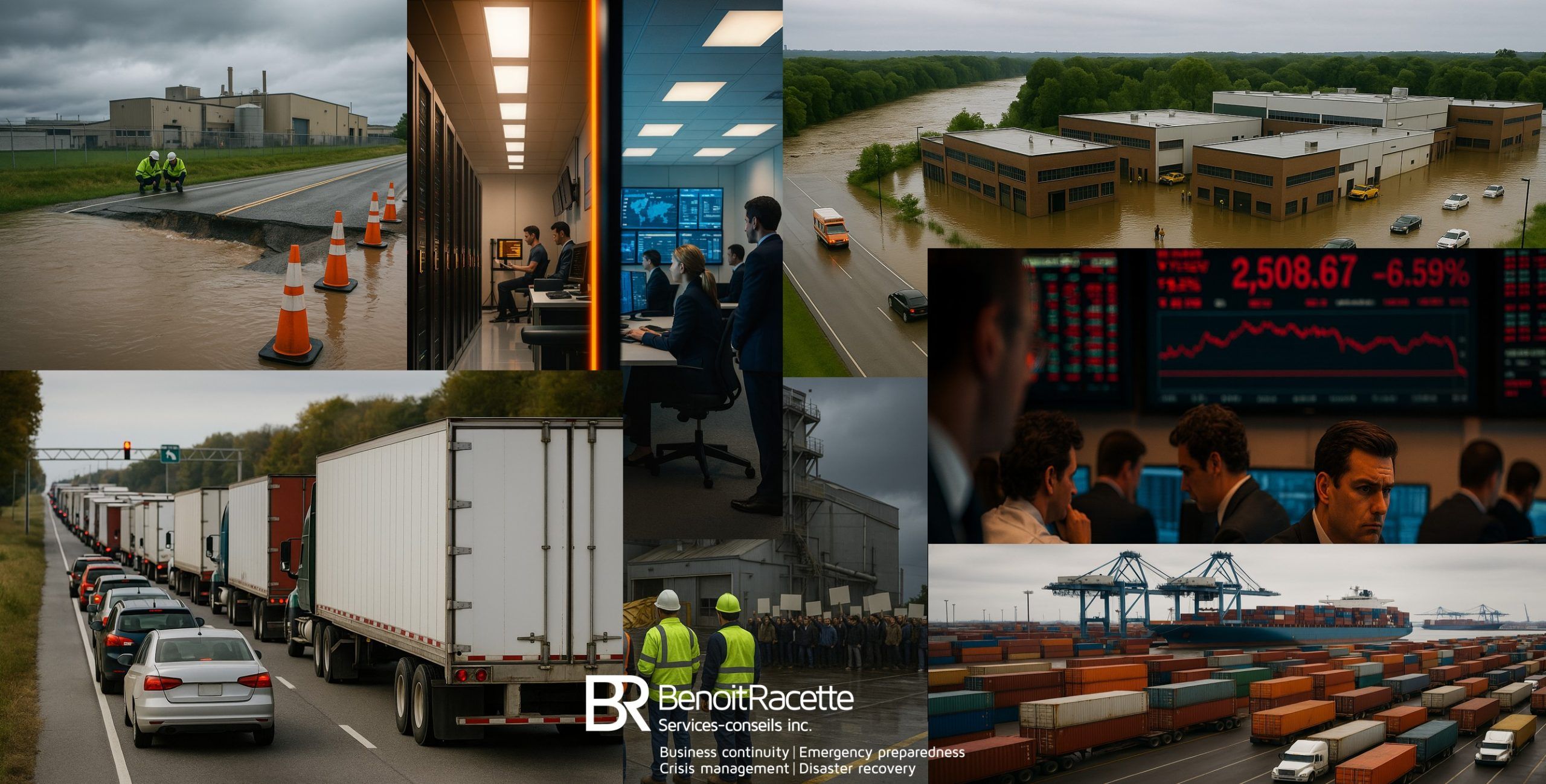
For years, organizations have relied on planning and forecasting to prepare for risk. But more and more, it’s not the predictable risks that disrupt operations—it’s the unexpected events, the sudden shocks, the surprises no one saw coming. Ransomware that paralyzes an organization in minutes. A key supplier that collapses overnight. A logistics route cut off by floods. A regulatory change that reshapes an entire industry. A sudden spike in operating costs that destabilizes margins.
We no longer operate in a world of simple uncertainty. We have entered the era of unpredictability.
Unpredictability goes beyond uncertainty
As professor Jean-François Caron (2013) explains, “unpredictability differs from uncertainty in that future events cannot be modeled or even assigned a probability.” In other words, unpredictability includes events that are outside known risk scenarios, events that challenge all standard planning assumptions.
Recent findings confirm this shift:
-
52% of Quebec businesses have been affected by a climate-related disruption in the last 12 months (Québec Net Positif / Ouranos, 2025).
-
National cybersecurity data shows a sustained increase in cyberattacks targeting Canadian organizations (CIRA Cybersecurity Report, 2024).
-
National economic analysis confirms that global supply chain fragility continues to expose Canadian businesses to delays and financial pressure (Government of Canada, State of Trade, 2024).
-
76% of business leaders are concerned about rising operational risk—but only 10% report having a structured plan to deal with it (Ouranos 2025).
The conclusion is clear: the element of surprise has become a major strategic risk factor for organizations.
Three sources of unpredictability
Unpredictability takes many forms but can be grouped into three main categories for operational and strategic analysis:
1. Technological and operational unpredictability
-
Cyberattacks (e.g., ransomware, data breaches)
-
Cloud or enterprise IT disruption
-
Power grid or telecom failures
-
Critical supplier failure
-
Breakdown of logistics dependencies
2. Environmental and social unpredictability
-
Extreme weather events (floods, wildfires, severe storms)
-
Climate-related infrastructure impact
-
Public health events
-
Staffing shortages and workforce disruption
-
Social unrest or security concerns
3. Economic, tariff and political unpredictability
-
Inflation and market volatility
-
Sudden increases in energy or transportation costs
-
Geopolitical uncertainty
-
Regulatory changes or government decisions
-
Trade or tariff restrictions affecting operations
Why traditional risk management is no longer enough
Traditional risk management is based on a three-step logic: identify – analyze – mitigate. This model works well for known or measurable risks, but it struggles when:
-
There is no historical data
-
Probability cannot be calculated
-
Systems react in non-linear ways
-
Impacts cascade across interdependencies
-
Time becomes a constraint more than a variable
-
Complex decisions must be made in partial visibility
In unpredictable situations, even mature organizations discover the limits of static recovery plans. What matters is not the existence of plans but the ability to adapt them under pressure.
Common mistakes organizations make
When facing unpredictability, many organizations fall into these traps:
-
Underestimating critical dependencies
-
Relying too heavily on insurance instead of resilience
-
Assuming low probability equals low priority
-
Confusing documentation with readiness
-
Neglecting decision agility under pressure
Preparation must evolve: from static plans to dynamic capability
Preparing for unpredictability does not mean predicting everything. It means building the capacity to continue operating during unexpected disruptions.
This requires three core organizational capabilities:
1. Absorption capacity
Reduce fragility
-
Identify and secure essential functions
-
Implement redundancy where it matters
-
Plan fallback options for critical dependencies
2. Adaptation capacity
Adjust quickly under pressure
-
Use modular contingency plans
-
Run simulation exercises regularly
-
Strengthen crisis governance
3. Agility capacity
Decide and act faster
-
Clarify decision paths and escalation mechanisms
-
Empower recovery teams
-
Promote a resilience-driven culture
Conclusion
Unpredictability is no longer an exception—it has become part of today’s operational reality. The organizations that will succeed are not the ones trying to control everything, but the ones building resilience by design: prepared to absorb impact, adapt rapidly and maintain continuity under pressure.
Further insight
I will be hosting a Café Continuité session with Réco-Québec on Wednesday, November 19 from 12:00 to 1:00 PM (online), focused on this topic:
“Unpredictability – how do we prepare for what we cannot predict?”
It will be an open discussion between professionals and practitioners about real strategies that work in complex environments.
Please note: this session will be conducted in French.
Info & registration: https://lnkd.in/e-GedY7U